Information for property owners
Acquiring property to build light rail to Tacoma
To construct the Tacoma Dome Link Extension (TDLE), Sound Transit will need to acquire property. In some cases, this may require residents or businesses to relocate. Please note that potential impacts to individual properties are not final and will continue to be refined as environmental review and design advance.
If you own property along the TDLE project corridor, you may have received a letter from Sound Transit in late 2024 about potential impacts from one or more route and station alternatives evaluated in the Draft Environmental Impact Statement (EIS), published in December 2024. Following the 60-day public comment period, the Sound Transit Board reviewed Tribal, agency, and public comments and identified the Preferred Alternative in June 2025.
Sound Transit is now preparing the Final EIS and continuing to advance the design. The Final EIS will include updated information about potentially affected properties. After the Final EIS is published, the Board is expected to select the project to be built. Property needs will continue to be refined through final design, and the Board will authorize specific acquisitions as needed. Depending on the project selected and final design, Sound Transit may need to acquire all or part of a property or certain property rights.
Project and property acquisition/relocation milestones
Sound Transit contacted potentially affected property owners.
Draft EIS available for public review and comments.
Sound Transit Board confirmed or modified the preferred alternative after considering comments from Tribes, agencies, and the public.
Final EIS development (we are here).
- Final EIS is published.
- Sound Transit Board selects the project to be built.
- Federal Record of Decision.
- Sound Transit continues to refine property rights needed for the project.
- The Board authorizes acquisitions as needed.
- Sound Transit will proceed with acquisition, and relocation assistance.
Not all properties needed for the project will be acquired at the same time. Property needs will become clearer after issuance of the Final EIS and Board selection of the project to be built. As design advances, we will continue refining this process. We understand that this uncertainty can be stressful. We are committed to keeping you informed throughout the process. If you have any questions, email tdlink@soundtransit.org or call 206-398-5453.
Need more info?
For more information about property acquisition and relocation, please refer to the following resources:
A draft list of potentially affected parcels can be found in Appendix H1 of the Draft EIS. This list is based on conceptual designs and the conditions at the time of the Draft EIS analysis. The list of potentially affected parcels will be updated for the Final EIS to reflect design advancements that have been made. After the Sound Transit Board selects the project to be built, the property needs will continue to be refined.
To search the appendix, use Ctrl+F (Windows) or Command+F (Mac) and enter the address or parcel number. Addresses are listed with postal abbreviations spelled out (for example, “Ave” is listed as “Avenue” and “St” as “Street”).
About the property acquisition and relocation process
Sound Transit follows federal, state, and local requirements designed to ensure property owners and tenants are treated fairly and consistently. Our policies and procedures describe how we work with property owners and tenants throughout acquisition and relocation. These requirements include 49 CFR Part 24, the Uniform Relocation Assistance, and Real Property Acquisition Policies Act of 1970, as amended (“URA”) and all applicable state and federal laws. For more information, read the Property Acquisition and Relocation Handbook for residential properties or for business properties.
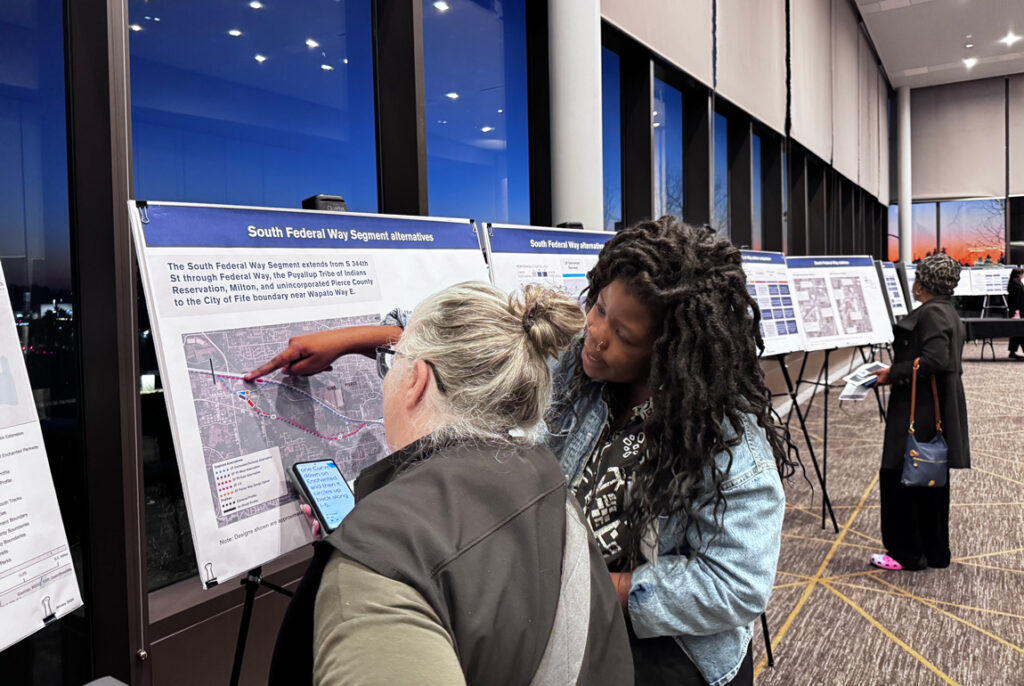 Project staff and a local resident discuss the project alternatives and potential property impacts at the Draft EIS public meeting in Federal Way.
Frequently Asked Questions
Sound Transit sent a preliminary letter to potentially affected property owners before releasing the Draft EIS in December 2024. A potentially affected property is located on or near one or more of the alternatives under study, which Sound Transit may need to acquire property rights to build the project. Being identified as potentially affected does not mean Sound Transit has decided to acquire your property.
Before the Final EIS is published, Sound Transit expects to send another letter to property owners whose properties are identified in the Final EIS as potentially affected. This will be another informational notice. This notice will not mean that Sound Transit is acquiring all or part of the property.
After the Final EIS is published, the Sound Transit Board is expected to select the project to be built in 2027. Property needs will continue to be refined as the project advances through final design. If Sound Transit later determines that specific property rights are needed from your property, we will contact you directly to share property-specific information about the acquisition process and next steps.
After publishing the Final EIS and the Board selects the project to be built, Sound Transit must then receive Federal Transit Administration (FTA) project approval, called the Record of Decision (ROD). Once the ROD is approved, identified property owners will begin receiving letters letting them know of upcoming Sound Transit Board actions authorizing the identified properties to move forward in the acquisition process.
After authorization by the Sound Transit Board, Sound Transit will begin the property acquisition process, which follows these steps:
- Appraisal is conducted by an independent appraiser to determine fair market value.
- Appraisal is reviewed by a second appraiser for compliance with proper methodology and appropriate value conclusions.
- Sound Transit will present the offer package to the property owner.
- Sound Transit negotiates to purchase the property.
- Sound Transit may reimburse for certain approved expenses, occurring at or after closing for voluntary transactions, and may include:
- Owner’s own appraisal
- Attorney to evaluate the offer
- Accounting review for tax purposes
- Residential occupants, businesses, or personal property displaced due to the project will be assigned a relocation agent who will meet with the property owner to explain relocation assistance, eligibility and entitlements.
To align with the construction schedule, property acquisition will occur in phases. In limited circumstances, such as protective purchases or hardship acquisitions, property acquisition may occur before completion of the project’s Final EIS, subject to FTA approval on a case-by-case basis.
Residential relocation
Sound Transit provides three primary types of residential relocation assistance, which are outlined in our handbook: advisory services, moving benefits, and replacement housing.
A qualified relocation specialist will work with displaced residents to determine needs, explain benefits, and provide support. For details, review the Property Acquisition and Residential Relocation Handbook.
Business relocation
Sound Transit provides three primary types of relocation assistance for eligible businesses, which are outlined in our handbook: advisory services, moving benefits, and business reestablishment (or an in-lieu fixed payment).
Eligibility depends on the specific circumstances of each business. For details, review the Property Acquisition and Business Relocation Handbook.
Q: What is the average time frame from the offer to closure of sale?
A: While each acquisition is unique, the process can take anywhere between 12-24 months.
Q: Does Sound Transit pay closing costs?
A: Sound Transit will pay for all normal sale expenses including escrow fees, title insurance, pre-payment penalties, mortgage release fee, recording fees and all typical costs related to conveying title. The sale will be exempt from real estate excise tax.
Q: If my house does have to be acquired and I must relocate, will I be guaranteed a similar house and location?
A: Sound Transit will make every effort to find comparable properties within the desired market.
Q: Is there a geographical boundary limit for relocation?
A: No, there is no geographical limit on where you can move. However, Sound Transit will only pay moving expenses within a 50-mile range.
Q: If there is a long delay between acquisition/relocation and when construction starts, will there be empty homes and businesses for several years?
A: While acquisitions are tied to the project schedule, it is possible that homes and businesses could be vacated prior to construction starting. If that occurs, Sound Transit will take appropriate measures to secure the properties until demolition can take place.
Q: What if I would rather close my business or retire instead of relocating my business?
A: All displaced businesses (except landlords) are eligible for a fixed moving payment instead of reimbursement for moving and re-establishment expenses. This payment equals the average annual net earnings from the two tax years immediately preceding the year of displacement.
Q: What happens if I decide to move out before Sound Transit offers to purchase the building?
A: Relocation benefits apply only to owners and occupants at the time an offer is made to purchase the building (after the Final EIS and Board Action). If you leave before that time, you will not be eligible for relocation assistance.
Questions?
We recognize that this period of uncertainty can be challenging. If you have questions, contact our team by emailing tdlink@soundtransit.org or calling 206-398-5453. We are here to help.
